

to interpret; to explain or understand the meaning of something; to give a particular reading to words, actions, or events; (about art:) to render a work in one's own way
Building blocks
tõlgen- → root, from tõlge (”translation”) or tõlk (”interpreter”)
-da- → builds the verb stem — not causative here
-ma → infinitive ending
So literally tõlgendama means: “to work out the meaning of something”
How to use it
What to remember
What you interpret is in the Partitive case (third base form)
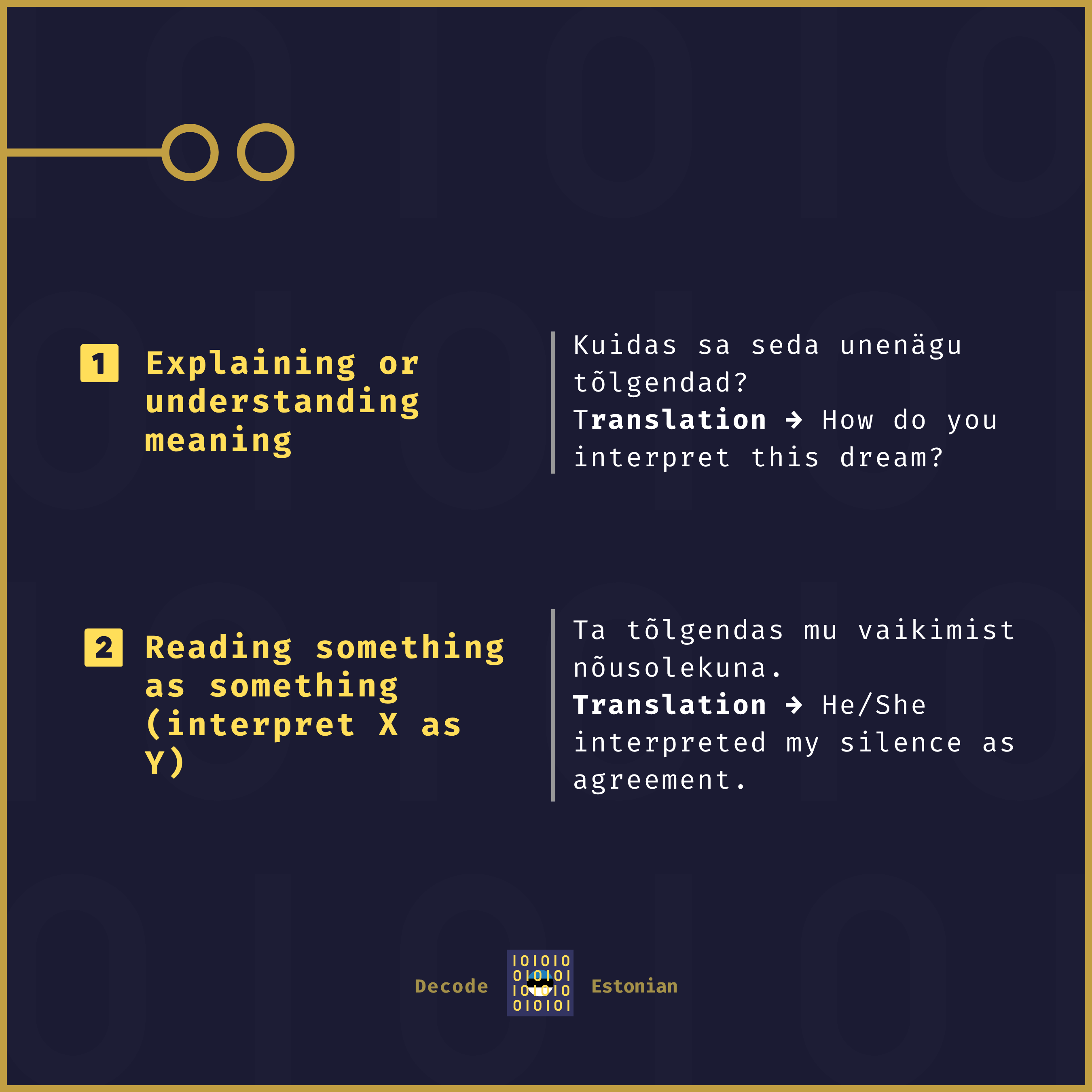
When you interpret X as Y, the Y takes the Essive ending -na (nõusolekuna = “as agreement”)
Example
Kohtunik tõlgendas seadust rangelt
Literally: “The judge interpreted the law strictly”
Idiomatically: “The judge interpreted the law strictly”
Kohtunik - Noun - Nominative Singular: "The judge"
tõlgendas - Verb - 3rd Person Singular, Past Tense: "interpreted"
seadust - Noun - Partitive Singular: "the law"
rangelt - Adverb: "strictly"
Ta tõlgendas mu vaikimist nõusolekuna
Literally: “He/She interpreted my silence agreement-as”
Idiomatically: “He/She took my silence as agreement"
Ta - Pronoun - Nominative Singular: "He/She"
tõlgendas - Verb - 3rd Person Singular, Past Tense: "interpreted"
mu - Pronoun - Genitive Singular: "my"
vaikimist - Noun - Partitive Singular: "silence"
nõusolekuna - Noun - Essive Singular: "as agreement"