

to find; to come across; to discover (something lost, hidden or searched for); to find (time, a solution, a way); (about opinions:) to think, to consider, to be of the opinion
Building blocks
leid- → root meaning “find” (on its own, leid is also a noun: a find)
-ma → infinitive ending
So literally leidma means: “to make a find”
🔓 Bonus decode: leid + -lik → leidlik, literally “find-ish” → someone who always finds a way → resourceful.
How to use it
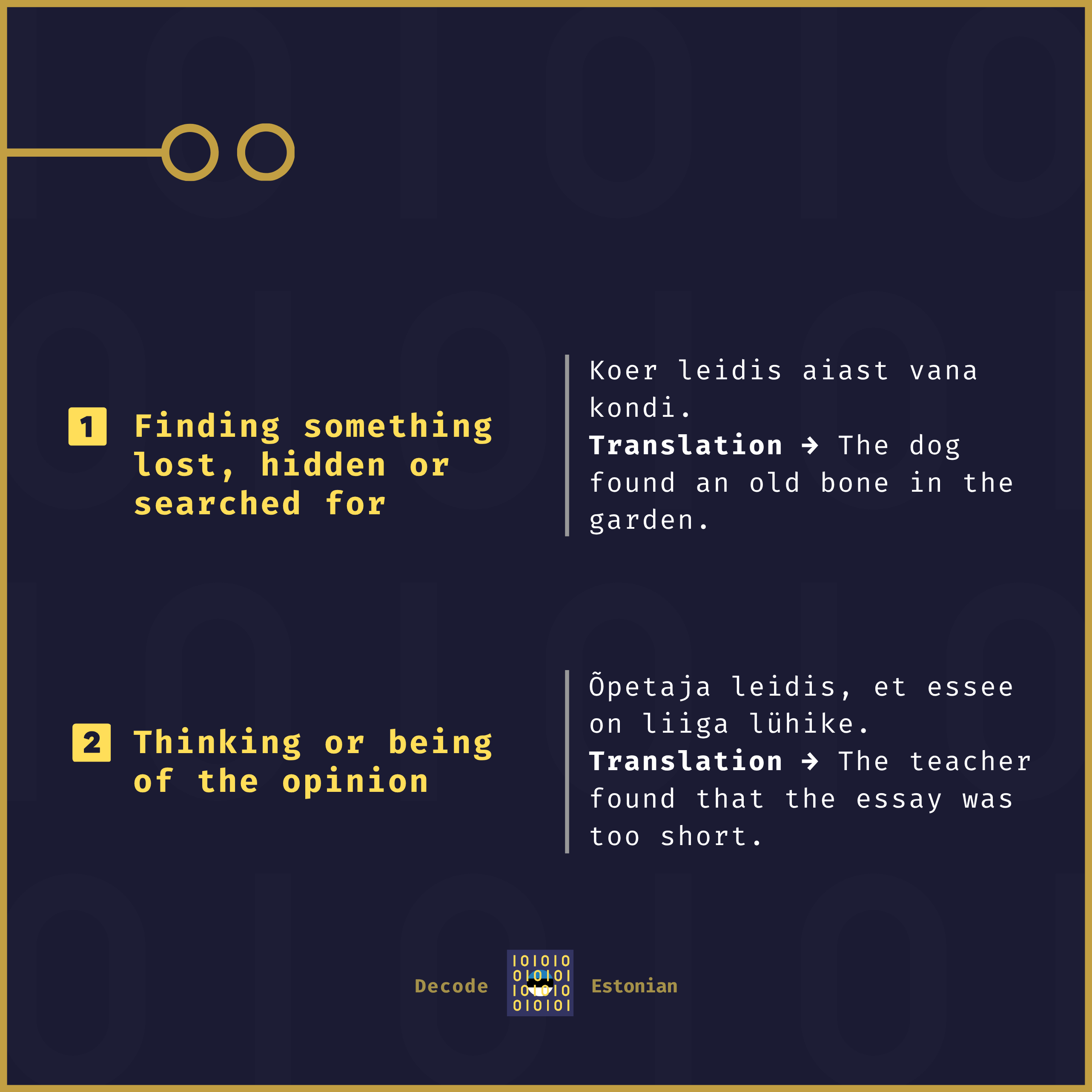
What to remember
In Estonian, you find things from a place, not in it. The place goes in a “from” case:
If the place takes -s (metsas), use the Elative -st (metsast).
If it takes -l (pööningul), use the Ablative -lt (pööningult).
Example
Vanaisa leidis pööningult vanu fotosid
Literally: “Grandpa found attic-from old photos”
Idiomatically: “Grandpa found some old photos in the attic”
Vanaisa - Noun - Nominative Singular: "Grandpa"
leidis - Verb - 3rd Person Singular, Past Tense: "found"
pööningult - Noun - Ablative Singular: "from the attic"
vanu - Adjective - Partitive Plural: "old"
fotosid - Noun - Partitive Plural: "photos"
💡 Watch the d: it disappears in the present tense (leian, leiab) and comes back in the past (leidsin, leidis).