


to discover; to find (something previously unknown); to explore; to find out, to realise; to notice (suddenly)
Building blocks
ava- → from the verb avama (to open)
-sta- → derivational suffix (turns “opening” into an action of revealing)
-ma → infinitive ending
So literally avastama means: “to open up (what was hidden)”
How to use it
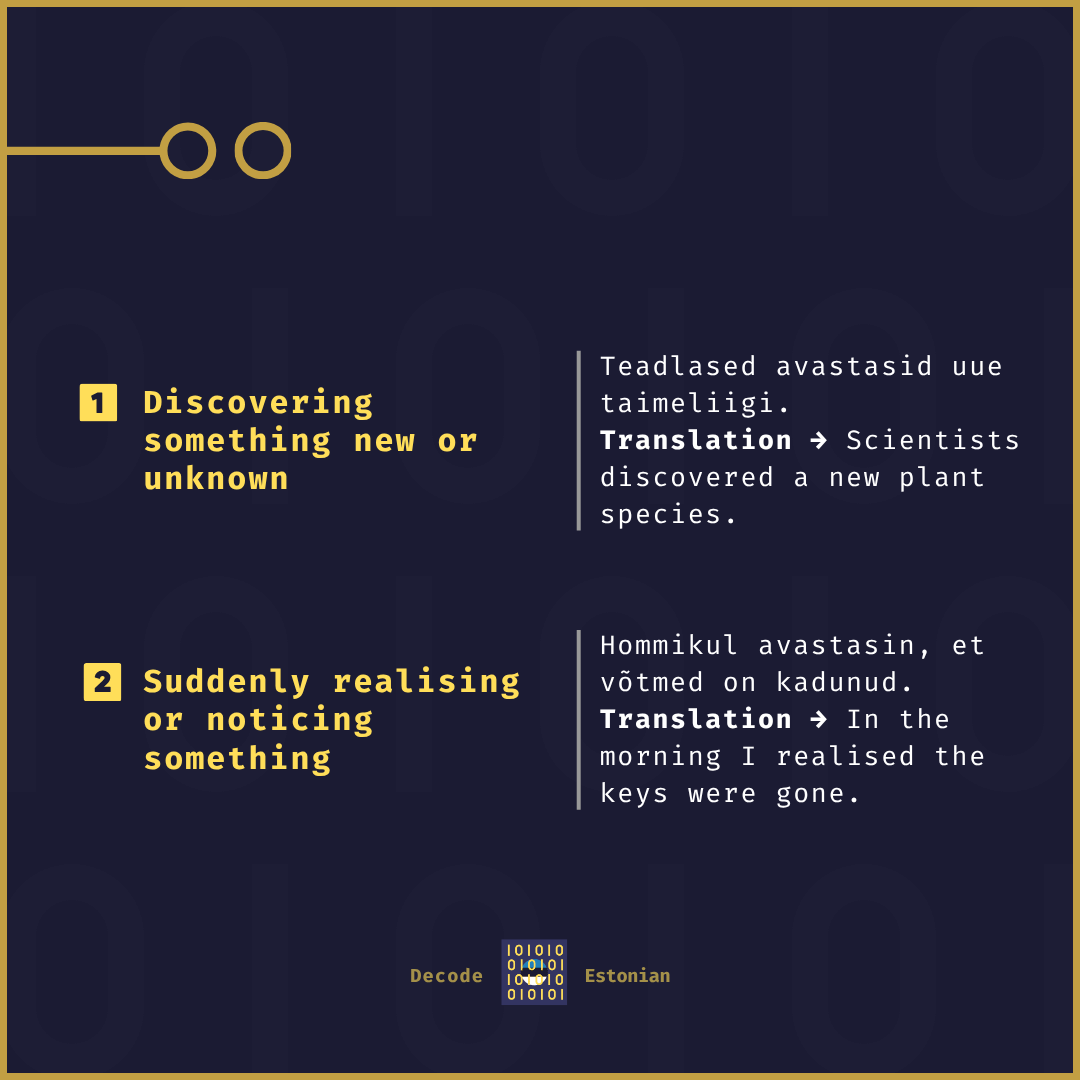
What to remember
When the discovery is complete (you found the thing), the object is in the Genitive case (second base form). When you’re still exploring, it’s in the Partitive case (third base form).
Example
Matkal avastasime metsas väikese järve
Literally: “Hike-on discovered-we forest-in small lake”
Idiomatically: “On the hike, we discovered a small lake in the forest”
Matkal - Noun - Adessive Singular: "on the hike"
avastasime - Verb - 1st Person Plural, Past Tense: "discovered"
metsas - Noun - Inessive Singular: "in the forest"
väikese - Adjective - Genitive Singular: "small"
järve - Noun - Genitive Singular: "lake"
Nädalavahetusel avastasime Tartu kohvikuid
Literally: “Weekend-on discovered-we Tartu cafés”
Idiomatically: “Over the weekend, we explored cafés in Tartu”
Nädalavahetusel - Noun - Adessive Singular: "at the weekend"
avastasime - Verb - 1st Person Plural, Past Tense: "discovered/explored"
Tartu - Proper Noun - Genitive Singular: "Tartu’s"
kohvikuid - Noun - Partitive Plural: "cafés"